



Across Europe, e-invoicing compliance is moving from a patchwork of national rules to a shared, mandatory standard, and multi-country hospitality operators are among the most exposed. Your invoice is compliant in the country you operate in today. Is it compliant in the next one? For most operators managing sites across multiple European markets, the honest answer is: they're not sure.

That is no longer a safe position. Germany's B2B e-invoicing mandate came into force in January 2025. France's nationwide PDP rollout begins in September 2026. Italy has required B2B e-invoicing since 2019. And under the EU's DAC7 directive, any platform processing income for property owners must report that income annually to tax authorities in every member state where its owners are based.
Compliance is not a future concern, but an operational reality today, and for multi-country operators, it is one of the most complex ones they face.
What's changing with e-invoicing compliance across Europe
The shift takes unstructured invoicing (PDFs sent by email) to machine-readable e-invoices that are validated, signed, and in some cases submitted directly to government platforms before reaching the recipient.
Each country has its own format and its own timeline:
- Germany: Requires XRechnung (pure XML) or ZUGFeRD (hybrid PDF and XML), both compliant with the EU's EN 16931 standard. Receiving e-invoices has been mandatory since January 2025; issuance requirements phase in for larger companies from 2027 and for all businesses by 2028.
- Italy: SDI (Sistema di Interscambio) has been mandatory for all B2B transactions since 2019. Every invoice must pass through the government's central exchange platform before delivery.
- France: Rolling out its PDP (Plateforme de Dématérialisation Partenaire, now also referred to as Plateforme Agréée) model. All B2B invoices must be routed through a certified partner platform, with the mandate starting September 2026 for large and mid-sized companies and September 2027 for SMEs.
- DAC7: Requires platforms that process rental income for property owners to file annual reports with tax authorities in every EU member state where their owners are based.
For an operator running parks in Germany, France and the Netherlands, that is potentially three different invoice formats, two submission platforms, and an annual DAC7 report, each with its own technical requirements.
Why e-invoicing compliance is harder for hospitality than other sectors
Most e-invoicing guides are written for B2B service businesses with simple invoice flows. Holiday parks have three layers of complexity that most sectors don't.
Multi-country, multi-entity operations
A group operating parks in three countries may need to comply with three different national mandates simultaneously, each with different formats and submission requirements. There is no single pan-European standard that covers all of them.
Owner management adds a B2B layer
When a platform manages sites on behalf of owners, owner settlements and payouts may themselves require compliant B2B invoicing under the laws of the country where the site is located. DAC7 adds a reporting obligation on top of this. Guest invoices and owner invoices have different compliance requirements and cannot always share the same technical pipeline.
Seasonal invoice volumes
Invoice volumes in hospitality peak at predictable times of year. End-of-season owner settlements, summer booking confirmations, and annual owner statements all create burst workloads. A compliance framework needs to handle these spikes without delays or failures.
How Maxxton delivers e-invoicing compliance: one framework, every country
The instinctive response to a new country mandate is to build a one-off solution. That works once. It doesn't scale.
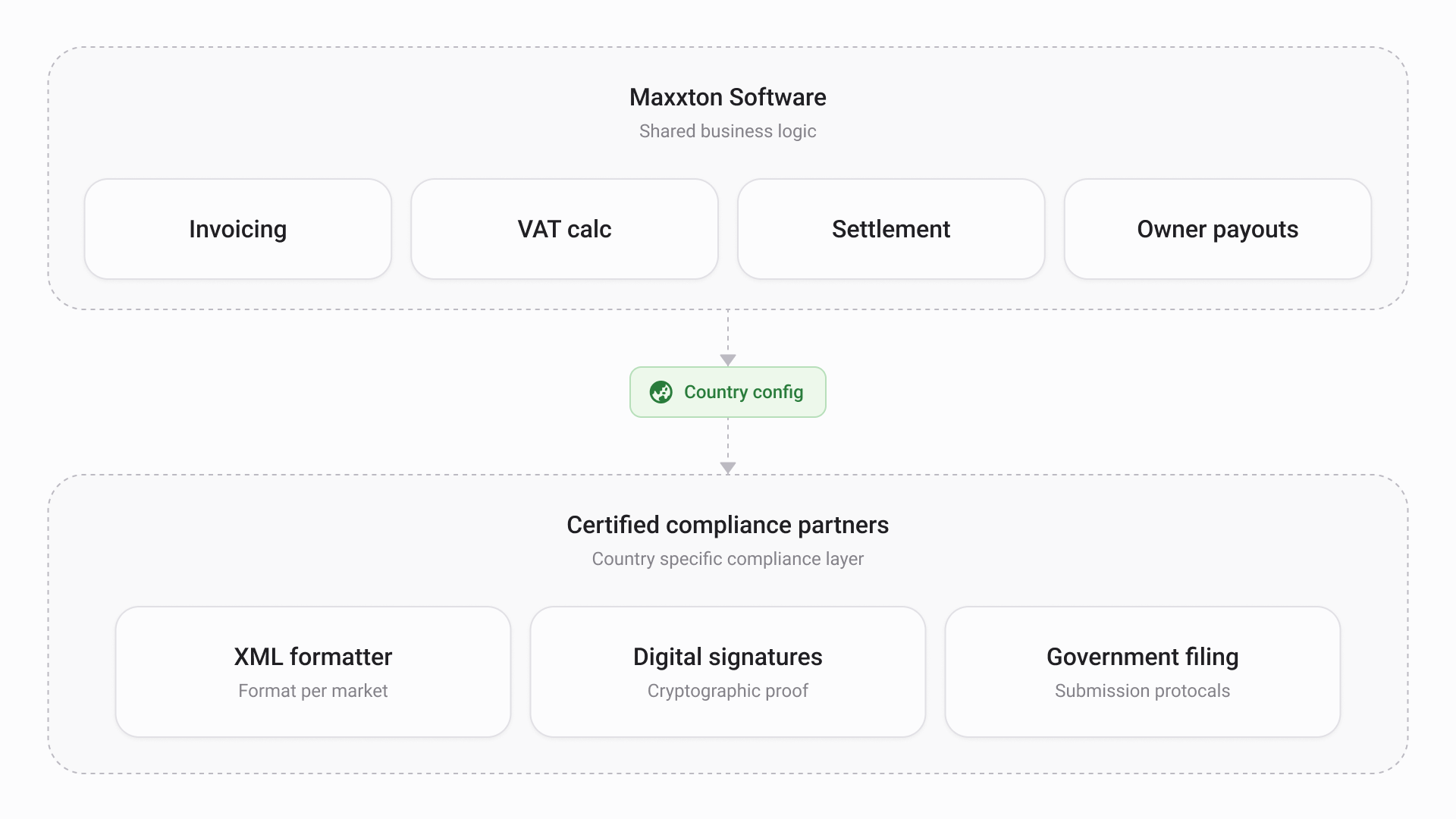
Maxxton's approach is a Generic European Invoice and Compliance Framework. It is a single architecture designed to handle any country's requirements through configuration rather than custom builds. The key principle is a clean separation of responsibilities:
- Maxxton owns the business logic: invoice generation, VAT calculation, settlement triggers and owner payout flows. This is shared across all markets.
- Certified partners own the compliance layer: the country-specific XML formats, digital signatures and government submission protocols.
- Adding a new country means configuring the right partner for that market, not rewriting invoice logic from scratch.
One part of that compliance layer is fiscalisation, the cryptographic signing of transactions required by law in several European markets. For example,Maxxton partners with Fiskaly for fiscalisation in Germany and Italy, ensuring transactions are signed and archived according to each country's tax authority rules. This integration forms part of the architectural foundation for Maxxton's broader compliance work.
The result is a compliance framework that grows with the regulatory calendar, not against it.
|
Without a compliance framework |
With Maxxton |
|
Invoice formats vary per country, with no standard approach |
One invoice engine, configured per country |
|
Each new mandate requires custom development |
New countries added via partner configuration |
|
Operators need to track regulatory changes themselves |
Maxxton monitors mandates and updates the framework |
|
Risk of non-compliance fines and rejected invoices |
Invoices validated, signed and submitted automatically |
|
Separate tools for fiscalisation, SDI submission, VAT reporting |
Single integration layer via certified compliance partners |
Where Maxxton's compliance rollout stands, and what it means for operators
Here is an honest picture of current compliance coverage:
- France (NF525): Live in production.
- Germany (XRechnung / ZUGFeRD): In scope for 2026. Architecture defined, partner integration being scoped, including fiscalisation via Fiskaly. Active client obligation driving delivery.
- Italy (SDI): In scope for 2026. Partner evaluation in progress, with Fiskaly handling fiscalisation. Technical dependencies with the Reservations team being resolved.
- Croatia, Belgium: In scope. Country-specific requirements being assessed.
- Spain (SII), Austria: Planned for H2 2026 and beyond.
The roadmap is sequenced by client obligation and regulatory deadline, not by ease of delivery.
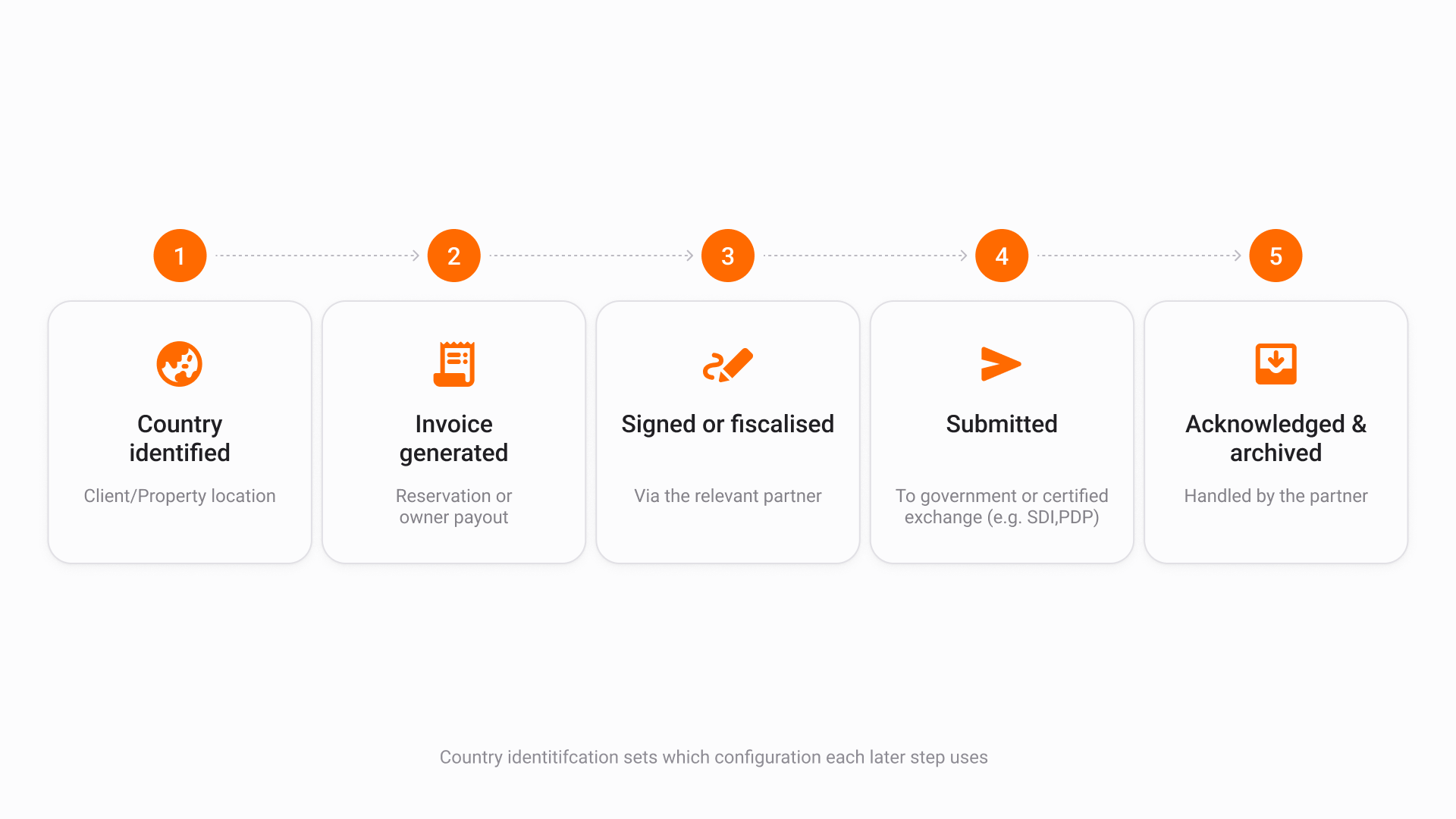
Compliance built into the platform means operators don't need to become compliance experts. Here is how it works for an operator using Maxxton:
- Invoice is generated in Maxxton based on the reservation, settlement, or owner payout.
- Country is identified and the correct compliance configuration is applied automatically.
- Invoice is signed or fiscalised via the relevant partner
- Invoice is submitted to the government platform or certified exchange where required (SDI, PDP).
- Acknowledgement and archiving are handled by the partner. No manual follow-up is required.
An operator in Germany does not need to understand the difference between XRechnung and ZUGFeRD. An operator in Italy does not need to manage an SDI configuration. The platform handles everything.
Key takeaways
- Germany's B2B e-invoicing mandate is live from January 2025. France and Italy are already in scope. DAC7 reporting is active now.
- Multi-country hospitality operators face multiple simultaneous e-invoicing compliance obligations, each with different formats, platforms and deadlines.
- Maxxton's Generic European Invoice and Compliance Framework handles this through a single architecture with country-specific partner integrations.
- Fiskaly handles fiscalisation for Maxxton in Germany and Italy; other certified partners handle structured invoice exchange and VAT submission (Italy SDI, France PDP).
- France (NF525) is already live. Germany and Italy are in scope for 2026.
- For operators, the goal is simple: compliance is invisible. The platform handles it end to end.


