

.jpeg?width=38&name=75F094E0-7F6A-46FA-873C-BA4783A1EEE1_1_105_c%20(1).jpeg)


From reservations to last-minute changes, hospitality runs on details. AI promises to make that work easier, but only if it cuts repetitive tasks without losing the personal touch.
Introduction
At Maxxton, that journey begins with the developers themselves. What started as experiments to make coding faster and cleaner has grown into a culture of sharing, testing, and improving with AI. By refining how developers work, Maxxton has laid the foundation for features that lighten the load for staff and make stays smoother for guests.
When Martin de Smit joined as an intern, he couldn’t have guessed he’d lead that effort. However, as Copilot became integral to daily development, his role expanded, and so did Maxxton’s approach to AI. Today, as AI Lead, Martin is focused on making life easier for developers, staff, and guests alike.
Learning by doing
AI first arrived in the team through experimentation. “I started experimenting with ChatGPT at the start of 2023,” Martin recalls. “Back then, it was very limited in its coding capabilities, but the arrival of Copilot changed that.”
Developers now embed AI across the stack. “We’re using it quite a lot, basically in every layer,” Martin says. “From infrastructure at the base up to developing the websites and the front end, and the more technical back end, which does the actual logic, including reservations and payments. Our developers are using AI in some form to simplify and help write code.”
The aim is not to replace developers with AI but to support them. “We really try to urge our developers to write their code with it as well, writing good prompts and getting the most out of AI,” he explains. “We don’t have independent agents running. It’s still a tool to help the developers instead of being basically an extra developer.”
Instead of formal workshops, Maxxton encourages developers to learn by sharing. Martin explains that the team has “mostly been focusing on letting them experiment,” then passing on what they discover. Dedicated Slack channels capture day-to-day tips, while internal blogs provide documentation about best practices that can be updated and reused when new colleagues start working with AI tools.
Those blogs make the approach concrete. One entry on front-end development warns: “Always review code that Copilot generates.” Another post on unit testing reminds: “AI will make mistakes, always review the generated tests or code.”
To keep everyone aligned, the AI team also organises monthly updates. “We use them to keep all employees informed on the latest developments and best practices,” Martin explains.
Testing has been an early success. “With most developers, testing is always a second thought,” Martin admits. “So how we can improve that with AI is a good example, but then of course we have to set up AI in the right way and give it the right information and context.”
From code to customer
AI has even changed how developers collaborate. Martin recalls that “previously, it was normal to ask your colleagues if you were unsure about something or had a bug you couldn’t fix.” Now, he says, many developers take an extra step first, turning to Copilot or ChatGPT before reaching out to a teammate.
The same culture of experimentation, validation, and sharing is shaping Maxxton’s platform. Martin explains that the team has “introduced AI very carefully with things like translations and automatically filling in content.” One example can be found in the Customer Care module: after a WhatsApp conversation, the system now generates a short title and summary note, allowing another agent to quickly grasp the context of the exchange without having to scan twenty messages.
The cautious approach extends across client-facing features. Revenue Management helps operators adjust prices with confidence. Deduplication clears guest records so loyalty programmes actually work. Add-on recommendations make upselling feel natural, a barbecue set in summer, a gourmet package in December, and are already driving most extras booked at some parks.
For Martin, these results reflect the culture that began with the developers themselves: small, practical gains that accumulate over time. “We use [AI] to make Maxxton Software more efficient,” he says, “but also our customers and our internal processes more efficient.”
Holding AI accountable
For Maxxton, adopting AI rests on three pillars: speed, efficiency, and, above all, trust. When you’re working with live bookings, payments, and guest data, a careless approach could do more harm than good, which is why governance has been central from the start. “Maxxton has always been on the stricter side with reviewing and validating code,” Martin explains. “So rolling into AI-generated code went pretty easily, as a human review by a senior has always been necessary.”
Security is equally important. “AI does indeed generate bad code if you ask the wrong questions. Garbage in, garbage out,” Martin says. “That’s why we make sure that once we select AI tools, they are verified, and we do security testing on them. We select large language models and AI tools where we are sure the data stays ours.”
That discipline provides clients with AI features they can trust to work reliably and securely, without the risk of errors, data leaks, or poor guest experiences that often accompany rushed technology.
Even with strong guardrails, AI isn’t perfect. “AI will make errors, generate broken code, and hallucinate,” Martin says, particularly in environments with hundreds of custom components. That’s why Maxxton focuses on adapting tools to its own context. “We’ve been customising and optimising our AI tools to give them the right information about our components, package versions, and syntax,” Martin explains. This way, the output fits our system and delivers value without compromising quality.
What's next
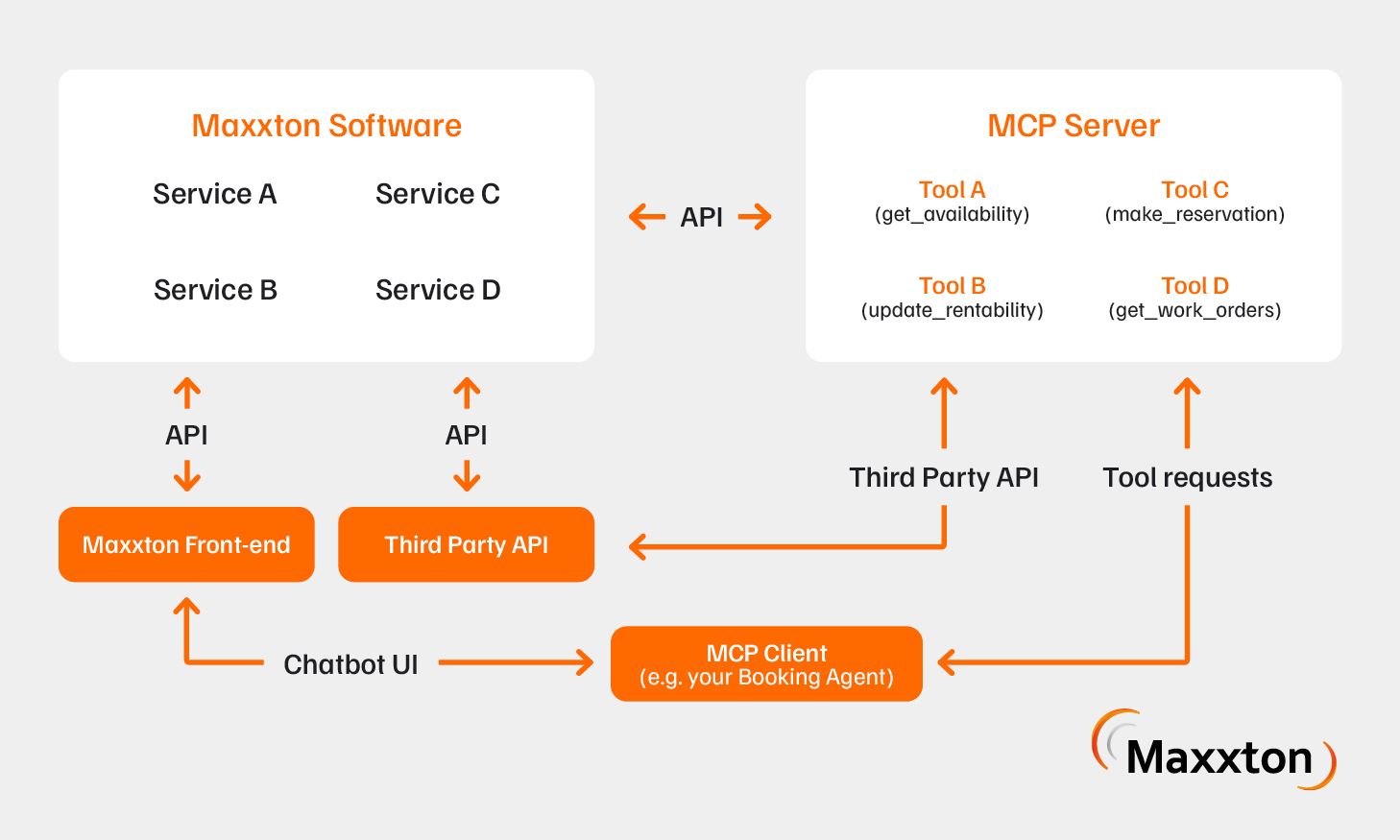
Looking ahead, Martin is most excited about Model Context Protocol (MCP). In simple terms, it’s a way to let AI work more directly with Maxxton’s system. The biggest change is for developers: MCP makes it much easier to integrate and build AI agents, as the connection with Maxxton Software is already established. In the future, Martin hopes that every developer will be able to interact with and develop AI tools in some form, and that capability will ultimately power more seamless features for staff and guests.
For now, MCP remains groundwork. “We tend to introduce AI very slowly, in very manageable, realistic, workable steps,” Martin explains. “It’s about building trust in the technology, both for our developers and for our customers.”
That pragmatism reflects Maxxton’s wider approach. AI has already delivered measurable results: faster development, improved workflows in customer care, and early revenue gains for clients. But the real story is how those results are achieved: carefully, step by step, with developers leading the way.
For hospitality, that means AI that actually delivers on its promises: removing repetitive work so staff can focus on guests. And for developers, it means a chance to shape smarter products without cutting corners. By starting with developers and scaling outward, Maxxton demonstrates how AI can evolve responsibly, setting the stage for a future where technology works quietly in the background and hospitality remains human at the forefront.


