




At Maxxton, data migration is an ongoing discipline. From onboarding new customers to integrating acquisitions, the team has built a repeatable, standardised process for moving operators onto Maxxton Software without losing what matters: guest records, live bookings, and financial clarity.
The migration process at a glance
If you are considering a switch to Maxxton, the migration follows five stages, each designed to reduce risk and keep you in control of your data.
- Data collection and assessment
You export from your legacy system; the Maxxton team reviews the files and maps fields across customer data, reservations, inventory, payments, and media. - Data transformation
Custom scripts convert your data into the standardised Maxxton import format, with pre-settings available for common source systems. - Test imports and validation
Multiple test imports on a test environment, validating performance, data quality, and completeness. You cross-check the results against your source data. - Cut-over
Stop sales on the old system; finalise export; finalise import into Maxxton; validate; reopen sales. Typically, within a single business day. - Post-migration
Deduplication is handled internally; historical data remains accessible for rebooking insights and loyalty programmes; and the standardised process is ready for any future acquisitions.
Now let’s dig into each stage in detail.

Why migration feels daunting
For operators weighing a platform switch, migration is often the sticking point. And the fear is understandable, an operator's data (guest profiles, bookings, inventory, payment records) represents years of business history. Losing any of it, or having it arrive incorrectly, can disrupt operations and erode trust.
No industry standard, so Maxxton is building one
Unlike e-commerce, where product data follows well-known international formats, the holiday and leisure industry has no universal standard for exchanging operational data. Every property management system structures its data differently, and operators often make matters more complex by tailoring the software to their needs.
The Maxxton team also rarely has visibility into the previous system's design. The outgoing provider is not going to hand over its data model, so the team works from export files and interprets the data based on what the client can tell them. The more implementations Maxxton completes from a given source system, the more mature and efficient the import process becomes.
To address this, Maxxton has been driving a standardisation effort. In the past, every client received a fully custom import, right down to temporary database tables named after the customer. The new approach follows a two-step model. First, custom scripts transform the incoming data into the standardised Maxxton import format. Then, a standardised import process takes over, with Maxxton Software expecting a defined data format with some flexibility in optional columns. Pre-settings already exist for common source systems such as e-Season, meaning clients migrating from familiar platforms benefit from a well-trodden path.
What gets migrated
The Maxxton migration covers four main data categories: customer and guest records, inventory, reservations, and payments. Each one has its own logic.
Customer data
Customer data is imported in full. All guest information, including addresses and phone numbers, is brought across. You won’t lose a single customer record.
The quality of incoming data, however, varies widely. It’s not uncommon for customer records to arrive in a messy state, with data crammed into the wrong fields, duplicates, or incomplete entries. The Maxxton team helps with cleanup during import, correcting and restructuring where needed. Deduplication, on the other hand, is handled by the software itself: all records are imported, and Maxxton Software resolves duplicates internally while preserving each guest's full history.
Inventory
Inventory (locations, accommodation types, units, add-ons, and rates) follows an already well-established import process, and it is one of the most crystallised parts of the migration: the standard for Maxxton Software is clearly defined, and the import templates are mature.
Some clients still prefer to configure inventory manually, allowing them to review and improve their setup as part of the transition. Even in those cases, the process involves a translation step in which the Maxxton team shares knowledge on managing the client's specific use case within the software before importing the data.
Reservations
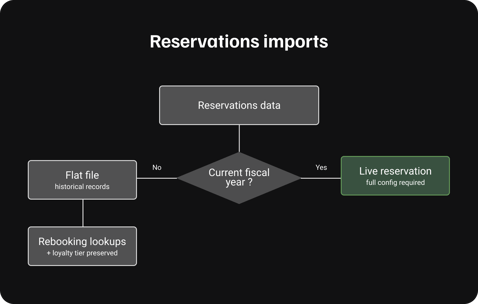
Reservations are handled in two tiers. Active bookings for the current fiscal year are fully imported as live reservations, connected to the configured inventory, pricing, and availability. A live booking must be supported by the full configuration: it must be bookable, valid, released, and priced correctly, with all related entities set up. That means importing active reservations requires a properly configured environment first.
Historical reservations (anything older than the current fiscal year) are stored in a flat file. This historical reservation table serves two purposes: it allows staff to look up a guest's past stays (so if someone calls to rebook last year's accommodation, they can be helped immediately), and it preserves loyalty programme status so that returning guests do not lose their loyalty tier. These records are far simpler to import, requiring only an arrival date, a departure date, and a customer record. Everything else is optional.
Payments
Payments are the area where complexity has grown most. Historically, importing payments was straightforward: a miscellaneous account was created for prior PMS payments, the amount paid was recorded, and any outstanding balance was carried forward. Simple.
Modern VAT regulations have changed that picture. In France, for example, receiving a payment triggers an automatic VAT reporting obligation. If payments that were already processed (and taxed) in the old system are imported as new payments into Maxxton Software, the system will generate a duplicate VAT report. To avoid this, Maxxton uses a deduction-based approach: instead of recording the previously paid amount as a payment, it is entered as a deduction add-on, which correctly reduces the outstanding balance without triggering a second VAT event. The amount can then be booked on the appropriate ledger for full financial transparency.
The simplest strategy overall is to time the cut-over at the start of a new on-sale year, before any payments have been collected on the new platform. This avoids the need to import payments entirely and significantly reduces complexity and risk.
Testing before going live
Before any live cut-over, the Maxxton team runs iterative test imports. The process starts internally on a development environment, then scales up to a test environment where the client can validate the results. The closer the go-live date gets, the more frequently these test imports are repeated, each time checking performance, lead time, data quality, and completeness.
Performance optimisation has been a particular focus. For one of Maxxton's largest clients, early projections estimated a full import time of 36 hours. Through targeted optimisation, it was brought down to approximately six hours.
Once the final import is done, the client cross-checks the results against their source data. By that point, though, most of the hard work is already behind them, as the real validation happened during the test cycles.
The cut-over
The moment of truth is the cut-over. Maxxton follows a clear cut-over strategy: at a defined moment, the old system stops accepting bookings or changes and is locked. The client creates a final export, delivers it to Maxxton, and the team runs the final import. Once the data is imported and validated, sales reopen, but now from Maxxton Software.
Typically, the cut-over begins at the end of a working day: exports are started, imports run overnight or early the next morning, and by the afternoon of the following business day, sales resume on the new platform. The whole process usually completes within a single business day.
Beyond the technical steps, the cut-over is also a matter of change management, because it’s essential that staff know exactly where to find the truth, which system holds the live data, from the moment the switch happens.
Equally important is the planning that happens before the cut-over. How ongoing reservations are handled, whether the client wants to complete the transition in one day or over a longer window, and what happens to any last-minute bookings. All of this is agreed with the client in advance. As long as the process is clear, the cut-over itself runs smoothly.
Migrations never really stop
For Maxxton's larger customers, migration isn’t a one-time project. Holiday park groups are constantly acquiring independent properties, and each acquisition means integrating a new location's data into an existing Maxxton environment.
And this is precisely why Maxxton is investing so heavily in standardising the migration process. The goal is to reach a point where customers who can deliver data in the Maxxton Software format can run migrations independently. For those who need help transforming data from an old system, Maxxton offers that as a professional service and makes the process repeatable regardless of how many locations are added over time.
What's next
The team is exploring further ways to reduce manual effort in the migration process. Address completion using AI and external address databases is one area under active investigation: recognising and correcting address data automatically rather than cleaning it by hand.
For operators considering a switch, Maxxton's migration process has been refined through real-world implementations, the tooling continues to improve, and the approach is built around clear communication at every step. Data migration will always involve complexity, but with the right process and the right team, it doesn’t have to be the reason to stay with the status quo.


