smart_toy AI agents for hospitality
Your teams don't search anymore. They ask.
Holiday park and campsite teams ask Max in their own words and get answers from live reservations, rates and configuration. Ton does the same for your guests.
Max is in use at
It knows your operations
Reservations, guests, rates and figures, read straight from the platform. Not a chat window on a help centre that only knows what the manual says.
It knows who is asking
Max inherits the rights of the person asking. A receptionist and a revenue manager can ask the same question and correctly get different answers.
It knows where you are
Max knows which module and screen you are working in, so "how do I do this here?" gets an answer for that exact screen.
Eight questions a day, all to the same colleague
A field worker's day at a park that runs on software people have to learn first.
- 08:05 “How do I move a check-in date again?”
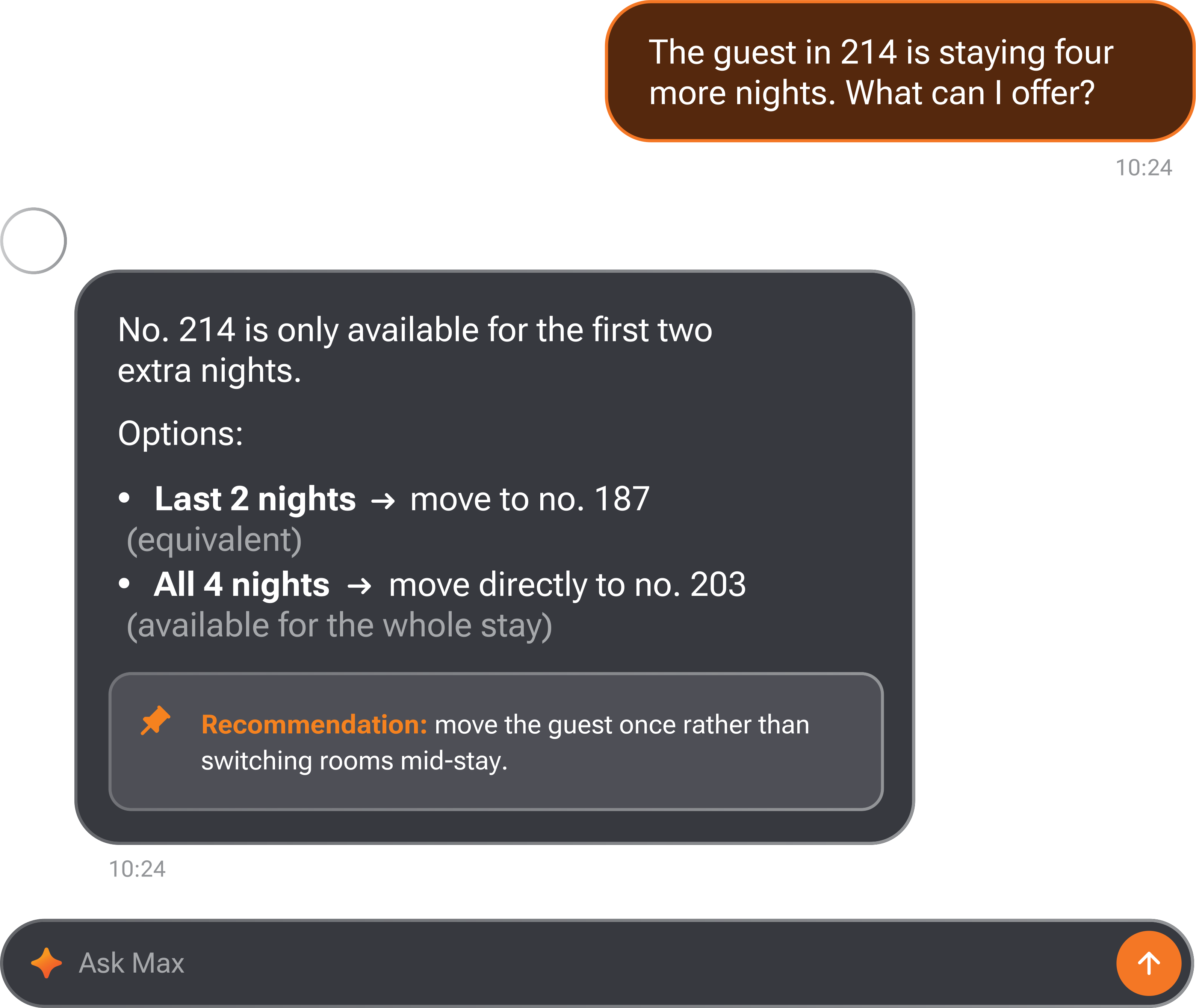
- 08:40 “The guest at the desk is early and his unit isn't ready. What else is free and clean?”
- 09:55 “Can you look up the Jansen reservation? He says he paid the deposit.”
- 11:20 “Who changed this reservation yesterday?”
- 13:10 “Can a dog stay in this accommodation type?”
- 14:30 “How many arrivals do we have on Saturday?”
- 15:45 “How do I raise a work order for a broken light?”
- 17:20 “Why did the price on this booking change?” Back office replies tomorrow morning.
Every one of these has an answer. It sits in the platform, or in the head of the colleague who has run the back office for years. The problem is not that your people ask too many questions. Your software only answers questions when people already know where to find the answer.
Max takes the question as they would put it to a colleague, finds the answer in your own data and configuration, and shows them where to act. At De Krim Texel, seven of those eight questions no longer reach the back office.
Max · for your teamsIn pilot
Ask it. Find it. Calculate it. Write it. Act on it
Five things your staff do all day, now done by asking.
Get answers
Step by step, for the module you are working in, with the source cited so you can check it or tell us the documentation is wrong.
How do I move a check-in date?
Find information
Max finds the reservation and gives you what you need: travel party, channel, who changed what and when. Lists as well as single records, without navigating four screens to reach one field.
Which bookings have the late check-out add-on?
Get insights
Max calculates the answer from your live figures, not from last month's export.
Occupancy per accommodation type in August versus last year.
Create content
A conversation becomes a clean support ticket, a work instruction is shortened for a colleague. Pilot users name this one first, because it ends the back-and-forth.
Write this up for support.
Take action
Max prepares changes to reservations, work orders or rates, and explains the consequences before anything moves. With your confirmation, Max executes the action.
Prepare a rate change for these dates.
Ready. 27 units affected from 12 to 19 July. Confirm?
AI that is already making a difference
For me, the value of AI lies in making daily work easier, so our staff have more time and attention for our guests.
Questions a day from field workers at De Krim Texel now resolved without the back office.
For a new employee at De Krim Texel to work independently.
Figures from De Krim Texel, where Max went live first. Libéma followed as the second pilot operator.
One AI assistant for every role at the park
Built from real questions asked at real front desks, contact centres and back offices, and tested with them before release.
“He's early and his unit isn't ready.”
Max finds one that is clean, same type, same dates, and shows where to switch it.
“A group of 15 next weekend, one accessible unit.”
Max returns what is free on those dates.
“Occupancy per accommodation type, August against last year.”
On live figures, in one sentence.
“What happens if I change this price rule?”
Max shows which dates, accommodation types and channels it touches before you act.
“How do I make this accommodation type bookable?”
The steps, in the module you are in, with the source cited.
“Write this up for support.”
A complete ticket, so the first reply is a fix rather than a question.
forumTon · for your guests
Conversational AI for your guests
Ton answers from what the platform already knows: your park information, your availability and the reservation behind the question.
Ton drafts. Your team sends.
Ton reads the guest's message and the reservation behind it, writes a suggested reply and hands it to whoever is on the inbox. Nothing reaches a guest unreviewed.
A chat widget, installed in about a minute
Ton answers guests in real time on your own site. A colleague can take over mid-conversation while Ton keeps reading along, and the conversation closes with a summary.
Where Ton is going
From the first search through booking, arrival, the stay and what comes after, across email, WhatsApp and phone. A guest who has stayed before gets a suggestion that already knows last year.
Most AI assistants read the manual. Our AI agents read your parks
What a third-party agent cannot do with your documentation alone.
It sits where the data lives
The reservation, the rate rule, the allotment and the configuration, plus the Help Centre. A third-party agent can read your manual. It cannot tell you why this reservation's price moved.
It knows how you work
A context layer, built with each operator, means answers reflect your own use of Maxxton rather than generic best practice.
It asks back
When a question is incomplete, Max asks which reservation you mean rather than guessing, and holds the thread through a multi-step configuration.
It speaks your team's language
Staff ask in their own language and get the answer in it, from one shared knowledge base. No internal documentation to translate per country.
It was tested with real roles
Used daily by pilot operators across pricing, configuration, communication, and the front desk, up to management. Its scope comes from their questions, not our assumptions.
A team improves it every week
We score every conversation and classify every gap. A dedicated AI team in Amsterdam builds what the agents learn they cannot yet do.
Every question your team asks improves the platform
The agents also show us where your people struggle with the software, question by question.
The answer exists, the agent had not learned it. A new Help Centre article, drafted from the conversation and approved by a person, closes it within days.
The platform can do it, the agent cannot reach it yet. We connect the agent to that part of the platform.
The platform cannot do it yet. It reaches the product teams as prioritised input from real usage.
An AI agent your IT and data protection officer can sign off on
The roles and rights you already set
Max has no rights of its own. It works within the roles set in user access management: view, create, edit, delete or execute per application, narrowed by location, distribution channel or cash account, and the GDPR access level on the role. No separate AI permissions to maintain.
A person confirms every change
Max reads and explains freely. Anything that changes data is prepared by Max and executed only with your confirmation.
Your data stays in Europe
Processed and stored in Europe on Google Cloud, inside the same environment and data protection as the rest of the platform.
Not used to train external models
Conversations are retained only to improve Max and Ton. Nothing is used to train external models.
Where Max and Ton work in the platform
Our AI agents, Max and Ton, read directly from the modules your teams already use, without keeping a copy of the data.
Guest help desk
Every guest email and message sits here with the booking attached. Ton reads both and drafts the reply, and AI already checks the wording of what your team sends.
Front desk management
Max sits next to the planning chart. Ask which accommodation is free and clean on the same dates, then switch the guest from the same screen.
Inventory setup
Accommodation types, units, amenities and rentability rules are defined here once. That is how Max knows that 187 is the same type as 214.
User access management
The roles, rights and GDPR access levels set here for each employee apply to Max too. Change a role once, and what Max can show or do for that person changes with it.
What operators ask before they switch it on
Are Max and Ton chatbots?
No. A chatbot reads documentation. Max reads your live reservations, rates, availability and configuration inside the platform, within the rights of the person asking. Ton answers guests from your own park information and the reservation behind their question.
What is the difference between an AI agent and an AI assistant?
An AI assistant answers from what it has been given to read. An AI agent works inside the platform: it looks up live data, calculates and, with your confirmation, acts. Max and Ton are conversational AI agents: you ask in your own words, and they work on your live data.
Can Max change data in our system?
Yes, but Max first prepares the reservation, work order or rate change and explains what it will affect for you to review and confirm. Nothing is executed until the person asking confirms, and Max can never do anything that person could not do themselves.
Who can see our data, and where is it processed?
Only users who could already see it. Max works within the roles, rights and GDPR access levels you already set in user access management, and has no broader view of its own. Data is processed and stored in Europe on Google Cloud.
Is our data used to train AI models?
No. We retain conversations only to improve Max and Ton, and we don't use them to train external models.
Does Ton talk to our guests directly?
No, not in Guest Help Desk: Ton drafts the reply and your team reviews and sends it. On your website, Ton answers guests in real time through a chat widget that is in preview and not yet live for operators. A colleague can take over any conversation.
Do new staff still need training on the software?
Far less. At De Krim Texel, it took a new employee about six weeks to work independently; now it takes roughly an hour because they ask Max instead of learning every screen first.
Bring the question your team asks most
Put it to Max in a demo, on your own Saturday scenario, and see where the answer comes from.