
De Krim Texel
- Hybrid · Netherlands · 10 sites
512 accommodation types and 27 accommodation kinds on one island, with 250 year-round pitch holders metered and settled annually alongside 300 privately owned units.
camping Campsite groups
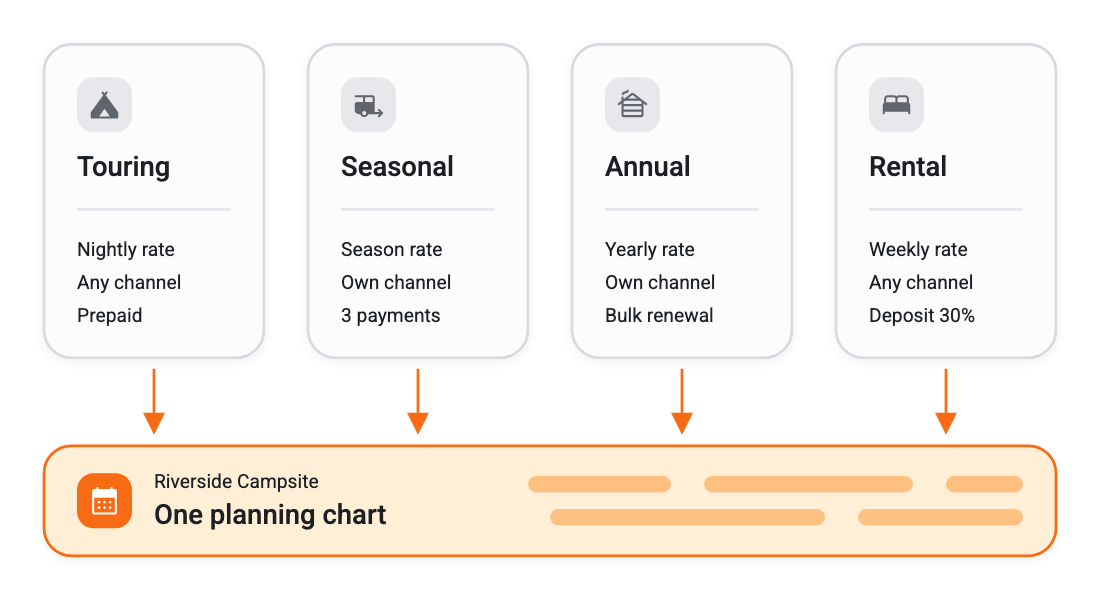
A touring pitch turns over in days. A seasonal pitch is let from March to October to a guest who owns what stands on it and identifies with the pitch number, not a reservation number. An annual pitch runs the full calendar and settles its own gas and electricity. Add rental accommodation on top, and that is four businesses sharing one site. Maxxton runs all four from one platform.

A campsite group earns most of its year in a few months, on land that is let in four different ways to four different kinds of guests. Maxxton's management software brings those letting models together.
Demand is rarely what limits growth. What limits it is how much of that complexity one team can hold together by hand.
Seasonal and annual pitch holders are your most valuable guests, and often the least visible ones. With Maxxton, their contracts, renewals, own-use rules and communication all run from the reservation, not from a folder and a mailing list.
Long-stay guests use gas, electricity and water like tenants. Take an advance on the booking, photograph the meter readings on a phone, and send a settlement invoice in the autumn to recover the revenue that estimating quietly loses.
Standard availability rules, such as a seven-night minimum stay, keep changeover manageable. They also leave gaps: odd two- or three-night stretches between bookings that nobody can sell because the rule blocks them. Maxxton lets you open those nights on just the pitches and dates where they occur, while the rule stays in place for everything else.
Maxxton runs 400+ locations, 13 countries and 50K+ accommodations across the platform, built for outdoor hospitality since 1998 rather than adapted from a hotel property management system. The figures below are live configuration today, from one Dutch operator running campsites and parks side by side.
Accommodation kinds in one concern, from touring pitch and hiker's cabin to villa and hotel room.
Source: De Krim Texel, live configuration
Accommodation types across 10 operating sites, on one hierarchy.
Source: De Krim Texel, live configuration
Year-round pitch holders, alongside 300 privately owned units in the same estate.
Source: De Krim Texel, live configuration
Distribution channels: 26 direct, 20 tour operator, 4 reseller.
Source: De Krim Texel, live configuration
Touring, camper, seasonal, annual and rental are each their own kind of accommodation in Maxxton, not workarounds. Seasonal and annual pitches are bookable through their own distribution channel, with their own payment schedules and communication flow, because a guest who has rented the same ground for nine seasons isn't a weekend booking. They still share one planning chart with everything else on site.
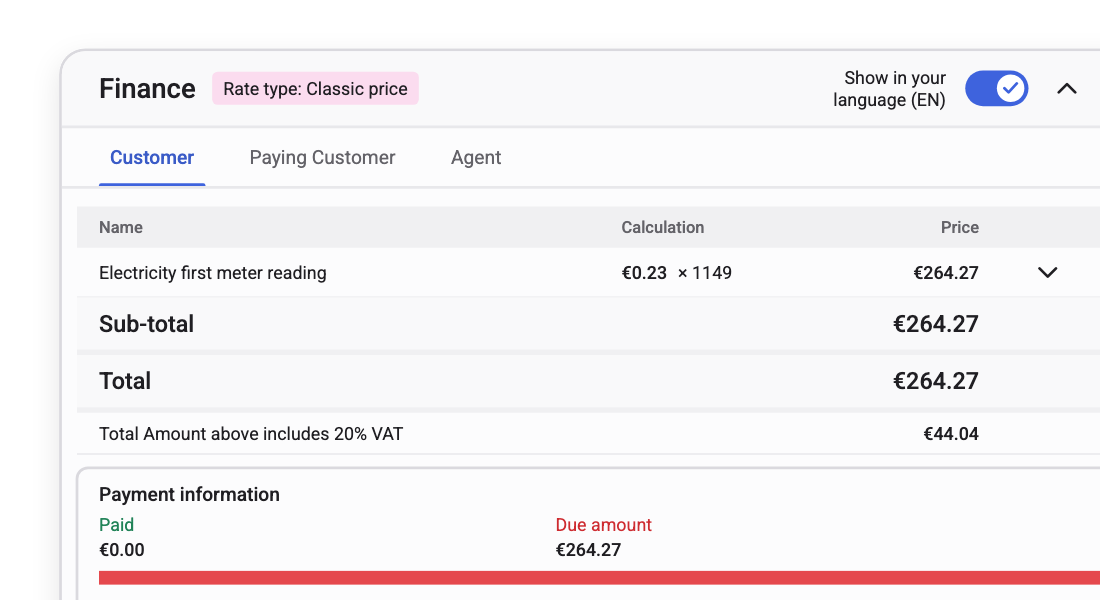
Seasonal and annual guests pay an energy advance with their reservation. Operations takes readings per pitch in the Operations App (photo included), and generates settlement invoices the following autumn, with an automatic refund if the advance was too high. A pitch with two gas meters is handled as two meters. Owner and pitch-holder invoicing follows its own annual calendar rather than being assembled by hand every year.
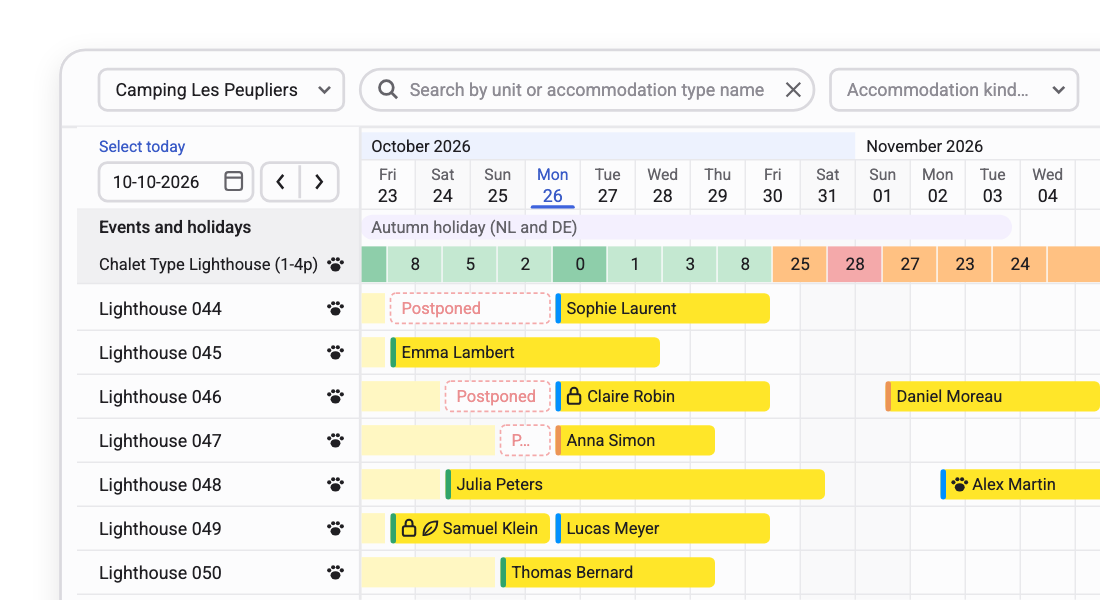
Housekeeping is planned against realistic time standards, and tasks follow what a guest actually booked, not just arrivals: a pre-made bed or a baby package schedules its own work. Access is set up per site and in layers: door locks, barriers, personal codes with licence plate recognition after first use, and pool entry as a separate right from site entry.
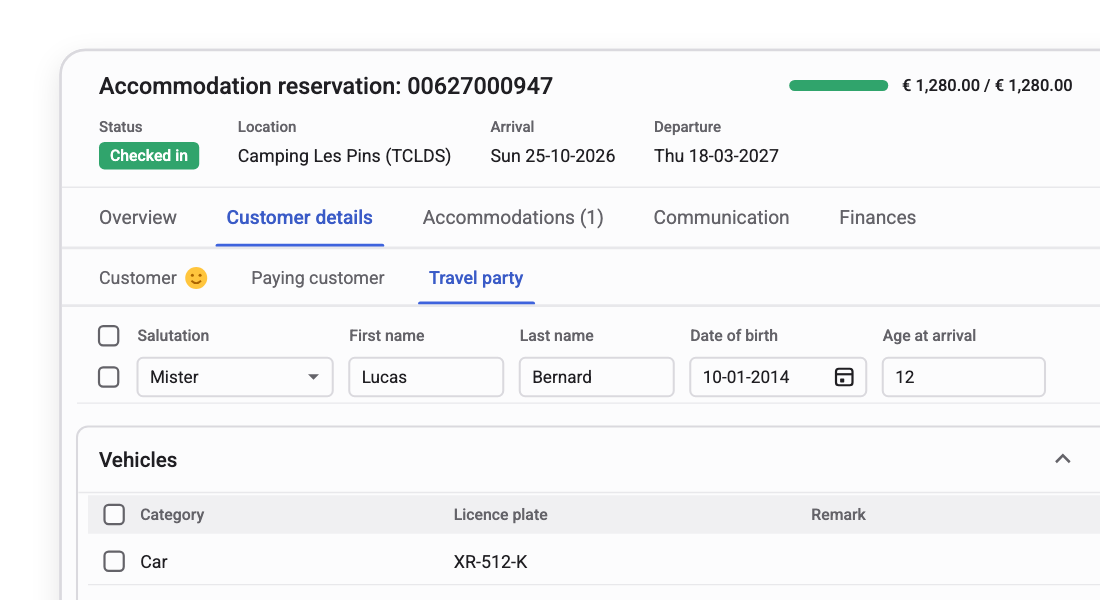
Direct, reception, tour operator and reseller channels all sell from one availability record, each with its own rates and commission. Guests book in their own language, complete their travel party and licence plate before arrival, and see the activity programme. Reviews, add-on recommendations and the guest portal work from the same reservation the rest of your business runs on.
“By digitising that process early on and getting Maxxton to support it, we optimised workflow efficiency. For example, housekeeping staff and technical service teams now receive notifications on their smartphones when a task needs to be completed.”
Jolanda Kamphuis Commercial Director, De Krim Texel
“After being accustomed to the previous system for 20 years, users tend to be resistant to new methods. However, by getting them accustomed to Maxxton software, we were able to win their trust.”
Bastiaan Spaapen Manager ICT, RCN Holiday Parks
“Occupancy is everything for us. With Maxxton, we can keep our campsites full, scale faster, and give our guests the service they expect.”
Marcel Janssen Co-owner and Director, Estivotravel
512 accommodation types and 27 accommodation kinds on one island, with 250 year-round pitch holders metered and settled annually alongside 300 privately owned units.
Runs everything from camping pitches to boat rental, with separate payment term sets per reservation category: tourist booking, seasonal pitch, yearly pitch and combined pitch.
Provincial recreation domain running dynamic pricing on the platform.
Leisure group combining accommodation with attractions, running dynamic pricing.
Onboarded in 2026, the newest campsite group on the platform.
German campsite operation running alongside KNAUS Campingparks.
Independent assurance over the controls that run your reservation and finance data.
Card data handled to the payment industry's own standard, across the estate.
French fiscal certification, live for operators with sites in France.
Owner reporting obligations met from platform data, not compiled separately.
Yes, as separate accommodation kinds in one estate rather than separate systems. One Maxxton operator runs multiple accommodation types across 10 operating sites, covering camping, camper, seasonal and annual pitches, furnished tents, group tents and hiker's cabins alongside bungalows, chalets, apartments and a hotel. Each has its own pricing model, booking window, changeover behaviour, and metering, but they share a single planning chart.
Maxxton handles energy billing through a yearly cycle rather than monthly bills: the reservation carries an advance, staff capture readings against the pitch in the Operations App with a required photo and settlement invoices generate the following autumn, with negative balances refunded automatically. Some annual pitches carry two gas meters, natural gas and propane, so the reading tooling supports selecting the first or second meter.
As bulk-copied yearly reservations, not thousands of manual rebookings. One operator carries roughly 83 of them on one site and 123 on another, renewed against next season's rates, charges and payment terms. Contracts run to a hard signing deadline, with first communication going out months ahead, and the platform drives that communication flow from the reservation rather than from a separate mailing list.
Yes. A seasonal guest rents the ground from roughly March to October, owns what stands on it, and identifies by pitch number rather than reservation number. Seasonal and annual pitches are separate accommodation types, bookable only through their own distribution channel, with their own communication flow, payment term sets, and a mandatory end-of-season clearance.
Yes, by overruling the general rule rather than editing it. Representation sets sit above the standard rentability rules and can tactically open shorter stays for specific accommodation types and date windows, for example, allowing single nights on units where only single nights remain. A reallocation engine additionally reshuffles existing bookings to free up sellable blocks.
One Maxxton operator runs 50 distribution channels: 26 direct, 20 tour operators, and 4 resellers. Named partners in that estate include Booking.com, Belvilla, Bungalowspecials, Voordeeluitjes, Holidu, CampVision, Micazu, Glampings, WeekendjeWeg and the regional tourist board. Beyond distribution, live integrations cover door locks and barriers, licence plate recognition, ticket printing, review platforms, accounting systems and single sign-on. Anything not pre-built connects through integration management, the OTA API standard or a documented REST API.
Yes. Financial Management flags outstanding balances and sends automatic payment reminders, with payments matched to the relevant reservation, extra or service.
Half the site turning over, the seasonal contracts due for signing, a summer of meter readings to settle and four channels selling the same touring pitch. An implementation consultant will walk you through it, not a slide deck.